
Backlinks: The Ultimate Guide to SEO Link Building & Ranking
Backlinks: The Definitive Guide to Building Authority and Ranking Higher in Google
In the world of SEO, few topics are as critical—or as misunderstood—as backlinks. They are the cornerstone of Google's original algorithm and remain one of the most powerful ranking factors today. Whether you're a seasoned marketer or just starting out, understanding backlinks is non-negotiable for achieving top search engine rankings. This comprehensive guide will demystify what backlinks are, explain precisely why they matter, and provide you with actionable, white-hat strategies to build a powerful backlink profile that drives both authority and traffic.
What Are Backlinks? (The Foundation of SEO)
A backlink, also known as an inbound link, is simply a hyperlink from one website to another. From the perspective of your website, it's a "vote" from an external site pointing to your content.
Think of it like a academic citation. When a reputable journal cites another study, it lends credibility and authority to the original work. Google's algorithm, particularly its foundational PageRank system, operates on a similar principle. It interprets a link from Page A to Page B as a vote of confidence from Page A for Page B's content.
Not all votes are created equal. A link from a highly trusted, authoritative site like Harvard University carries far more weight than a link from a new, unknown blog. This concept of transferred authority is why SEO professionals obsess over backlink quality, not just quantity.
If you want an easier way to organize, track, and manage your backlinks while autofilling submission forms, you can try BacklinkHelper — a free browser extension for SEO users that helps you quickly autofill link forms, generate natural comments, manage, de-duplicate, and trace backlinks.
Why Are Backlinks So Important for SEO?
The significance of backlinks extends far beyond a simple metric. They are a primary driver of organic growth for three fundamental reasons.
1. A Primary Google Ranking Factor
Multiple industry studies and confirmations from Google itself consistently place backlinks among the top three ranking factors. Our own analysis of 11.8 million search results found that the number one result in Google has nearly four times more backlinks than positions 2-10. Google's algorithms use these links to crawl the web, discover new pages, and determine a page's value and relevance in relation to a search query.
2. They Build Domain Authority and Trust
Backlinks are a direct signal of E-E-A-T (Experience, Expertise, Authoritativeness, Trustworthiness). When reputable, topically relevant sites link to you, they are essentially vouching for your content's quality. This tells Google that your site is a credible resource, which is essential for ranking competitive keywords.
3. They Drive Direct Referral Traffic
Beyond SEO, backlinks are a vital source of qualified traffic. A click from a relevant website brings users who are already interested in your niche directly to your site. This can lead to increased brand awareness, conversions, and a broader audience.
What Makes a High-Quality Backlink? (The 5 Key Traits)
Pursuing any backlink is a wasted effort. To maximize your SEO impact, focus on acquiring links that share these five traits:
- From an Authoritative, Trusted Source: A link from an established industry leader (e.g., Forbes, TechCrunch, or a leading blog in your niche) is infinitely more valuable than dozens of links from low-authority, spammy sites. Tools like Semrush's Domain Authority score can help gauge a site's strength.
- Relevant Anchor Text: The clickable text of a link should be relevant to the page it's pointing to. Natural, descriptive anchor text (e.g., "definitive guide to backlinks") helps Google understand the context of your content. Avoid over-optimized, exact-match keyword stuffing, which can trigger Google's Penguin algorithm penalty.
- Topically Relevant Context: The link should come from a site and a page that is related to your content. A link from a running blog to your marathon training guide is powerful. A link from a fishing blog to that same guide is not.
- A "Dofollow" Link: By default, most links are "dofollow," meaning they allow PageRank to pass. Links with a
rel="nofollow"tag (common in blog comments, press releases, and paid ads) instruct search engines to ignore them for ranking purposes. - From a Unique Referring Domain: Diversity is key. It's better to have one link from 100 different websites than 100 links from one website. Our research shows that the number of unique referring domains correlates more strongly with high rankings than the total number of backlinks.
7 Proven Strategies to Build Powerful Backlinks
Now for the actionable part. Here are seven effective tactics to earn high-quality backlinks.
1. Create Irresistible Linkable Assets
You can't earn links without something worth linking to. This is the cornerstone of all link building. A linkable asset is a piece of exceptionally valuable content that serves as a natural link magnet. Examples include:
- Ultimate Guides: Deep, comprehensive resources (e.g., "The Ultimate Guide to YouTube SEO").
- Original Data & Research: Conducting your own surveys and publishing the unique results.
- High-Quality Tools: Free software or calculators that solve a common problem.
- Engaging Visuals: Infographics, interactive charts, or compelling videos.
Example: Backlinko's "200+ Google Ranking Factors" guide took weeks to compile but has generated over 35,600 backlinks from 8,400 unique domains.
2. Harness the Power of Broken Link Building
This tactic involves finding broken links (404 errors) on relevant resource pages in your niche and suggesting your content as a replacement.
- Find resource pages using Google searches like:
"your niche" + "resources"or"your niche" + "useful links". - Use a tool like the Check My Links Chrome extension to quickly identify broken links on those pages.
- Email the webmaster, politely notifying them of the broken link and suggesting your relevant content as a helpful replacement.
3. Execute the Moving Man Method
A cousin to broken link building, this involves finding outdated or rebranded resources and reaching out to sites that still link to them. Offer your up-to-date content as a better alternative for their readers.
4. Contribute High-Value Guest Posts
Guest posting is not dead. Writing authoritative content for other blogs in your industry remains a fantastic way to earn a contextual, dofollow link in your author bio. The key is quality over quantity. Target reputable sites that your audience reads. Use reverse image search to find where influencers in your space have guest posted by searching for their author headshot.
5. Reclaim Unlinked Mentions
Often, brands or products are mentioned online without a link. Use a monitoring tool like Google Alerts, Mention.com, or Semrush's Brand Monitoring to find these citations. Then, send a friendly email to the author, thank them for the mention, and politely ask if they would consider adding a link to make it easier for their readers to find you.
6. Leverage PR and Expert Platforms
Platforms like Help a Reporter Out (HARO) and its alternatives connect journalists with expert sources. By signing up as a source and responding to relevant queries with insightful commentary, you can earn high-authority backlinks from major news and industry publications.
7. Analyze Your Competitors' Backlinks
Your competitors are a goldmine of opportunity. Use a backlink analysis tool (like Ahrefs, Semrush, or Moz) to see who is linking to your competitors' sites. These are websites that are clearly open to linking out to content in your niche. Reverse-engineer their strategy and pitch them your superior content.
Common Backlink Building Mistakes to Avoid
- Buying Links: This directly violates Google's Webmaster Guidelines and can result in severe manual penalties.
- Over-Optimized Anchor Text: Using the same keyword-rich anchor text too frequently looks manipulative.
- Ignoring Relevance: A link from a completely unrelated site is at best worthless and at worst harmful.
- Neglecting Nofollow Links: While they don't pass PageRank, they can still drive traffic and are a part of a natural link profile. Don't ignore them entirely.
Frequently Asked Questions About Backlinks
1. How many backlinks do I need to rank? There is no set number. Focus on the quality of links from authoritative, relevant sites rather than the sheer quantity. One powerful link can be more impactful than 1,000 low-quality ones.
2. Are .edu or .gov backlinks more valuable? Only if they are relevant. A link from a relevant .edu blog post is valuable because the site is authoritative, not because of the TLD itself. Pursuing irrelevant .edu links is a waste of time.
3. How long does it take for a backlink to impact rankings? Google crawls the web continuously, but it can take several weeks for them to find a new link and factor it into their ranking algorithms. The impact is also not always immediate.
4. Do social media links count as backlinks?
Most social media links are nofollow and therefore do not directly impact PageRank. However, they are crucial for visibility, content discovery, and driving traffic, which can indirectly lead to natural backlinks.
Conclusion
Backlinks remain the currency of authority in the SEO world. By shifting your focus from quantity to quality and implementing the strategic, white-hat tactics outlined in this guide—like creating link-worthy assets, strategic outreach, and competitor analysis—you will build a backlink profile that not only satisfies Google's algorithms but also drives meaningful, sustainable traffic to your website. Stop chasing shortcuts and start building real authority. Your future rankings will thank you for it.
Recommendations
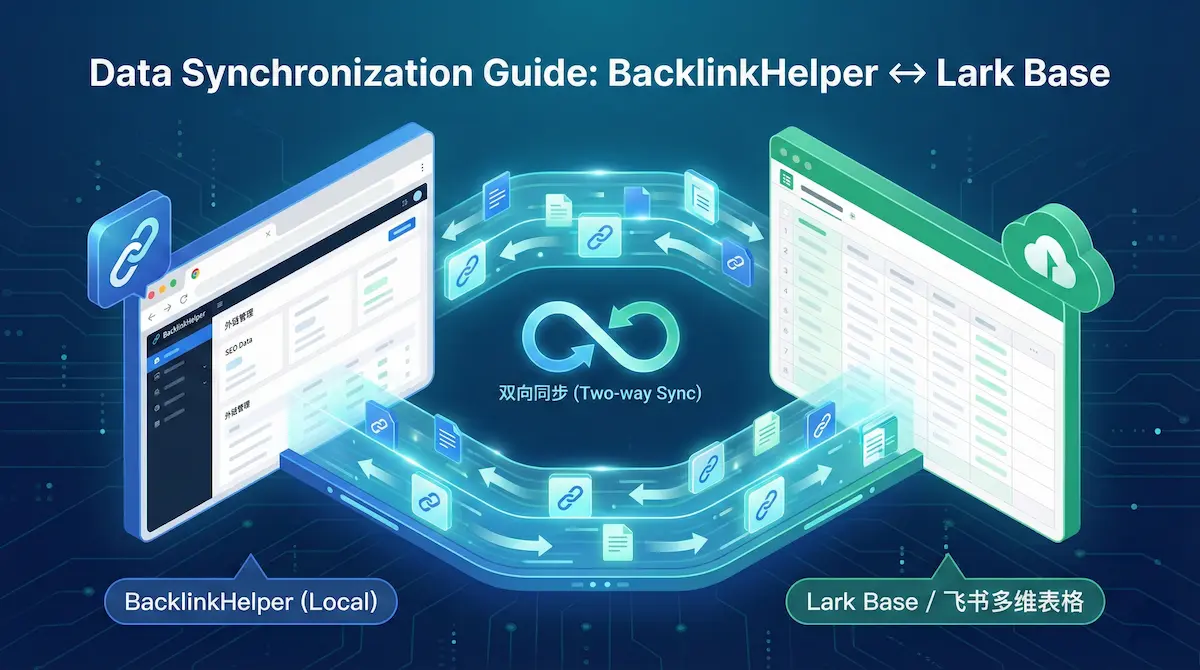
Lark Base (Feishu) Data Sync Guide | BacklinkHelper Manual
Learn how to set up two-way synchronization between BacklinkHelper and Lark Base (Feishu). A step-by-step guide on API authorization, group binding, and auto-sync features.

Automate Blog Commenting: The Safe 'Cyborg' Strategy
Let's be real: manual commenting sucks. Here is how to use AI and smart tools to automate the boring parts without getting your site penalized.
How to Track Guest Post Links Free: A Real-World Guide
Stop paying for expensive SEO tools just to track links. Learn the practical, free ways to monitor your guest posts using Google Sheets, GSC, and smart free tools.
Comments
No comments yet